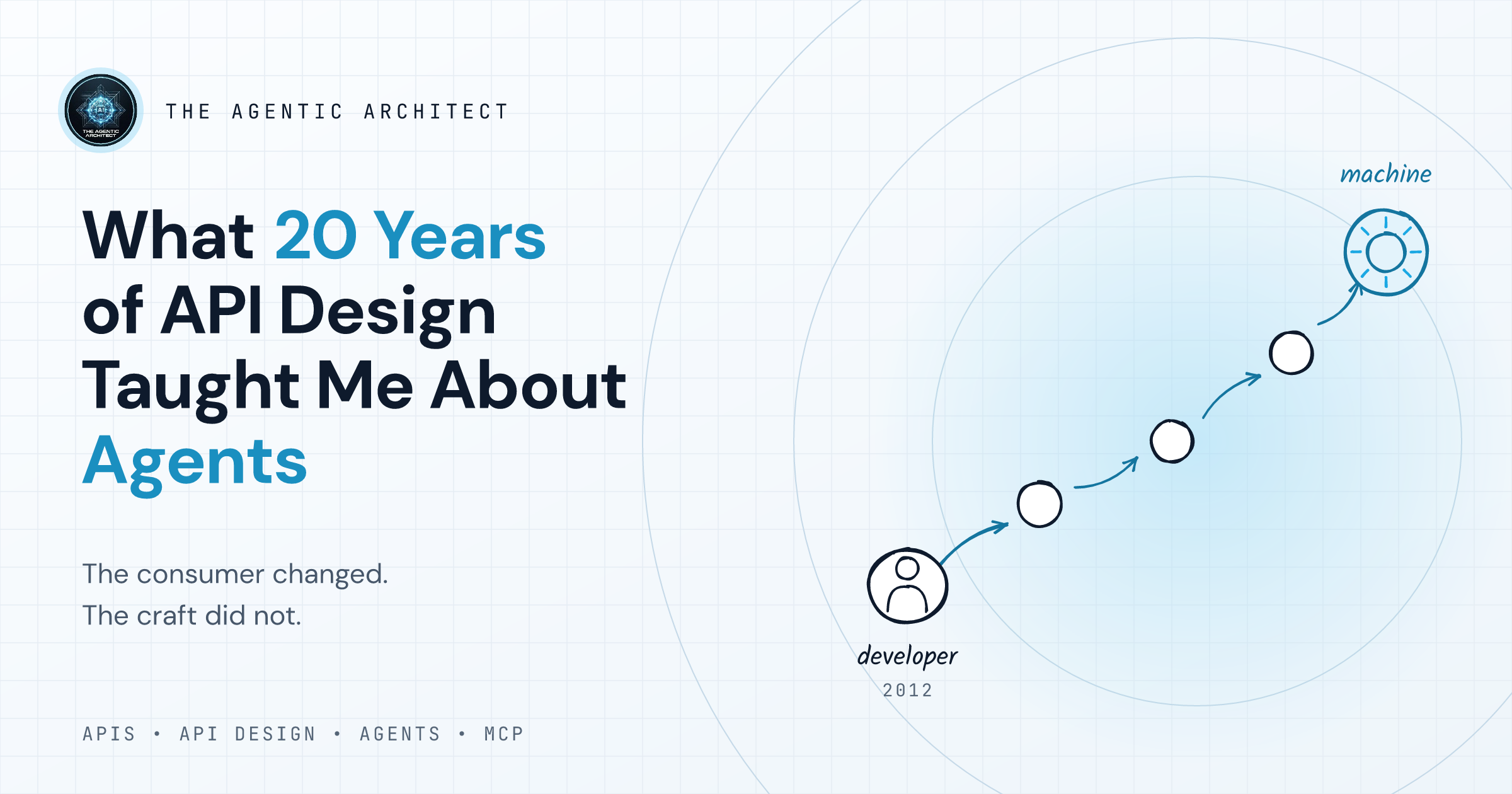
What 20 Years of API Design Taught Me About Agents — a timeline from API design to agents with the consumer changing from developer to machine

What 20 Years of API Design Taught Me About Agents

I started writing about API design in 2012. Back then the question was how to make an API good enough that a developer would pick it, learn it quickly, and keep using it. Since then the question has barely changed, but the reader has. The consumer is no longer only a developer reading documentation at a desk. Increasingly it is an agent, working from whatever it can discover and understand at runtime. ...
November 10, 2026 · 8 min · 1518 words · Hugo Guerrero
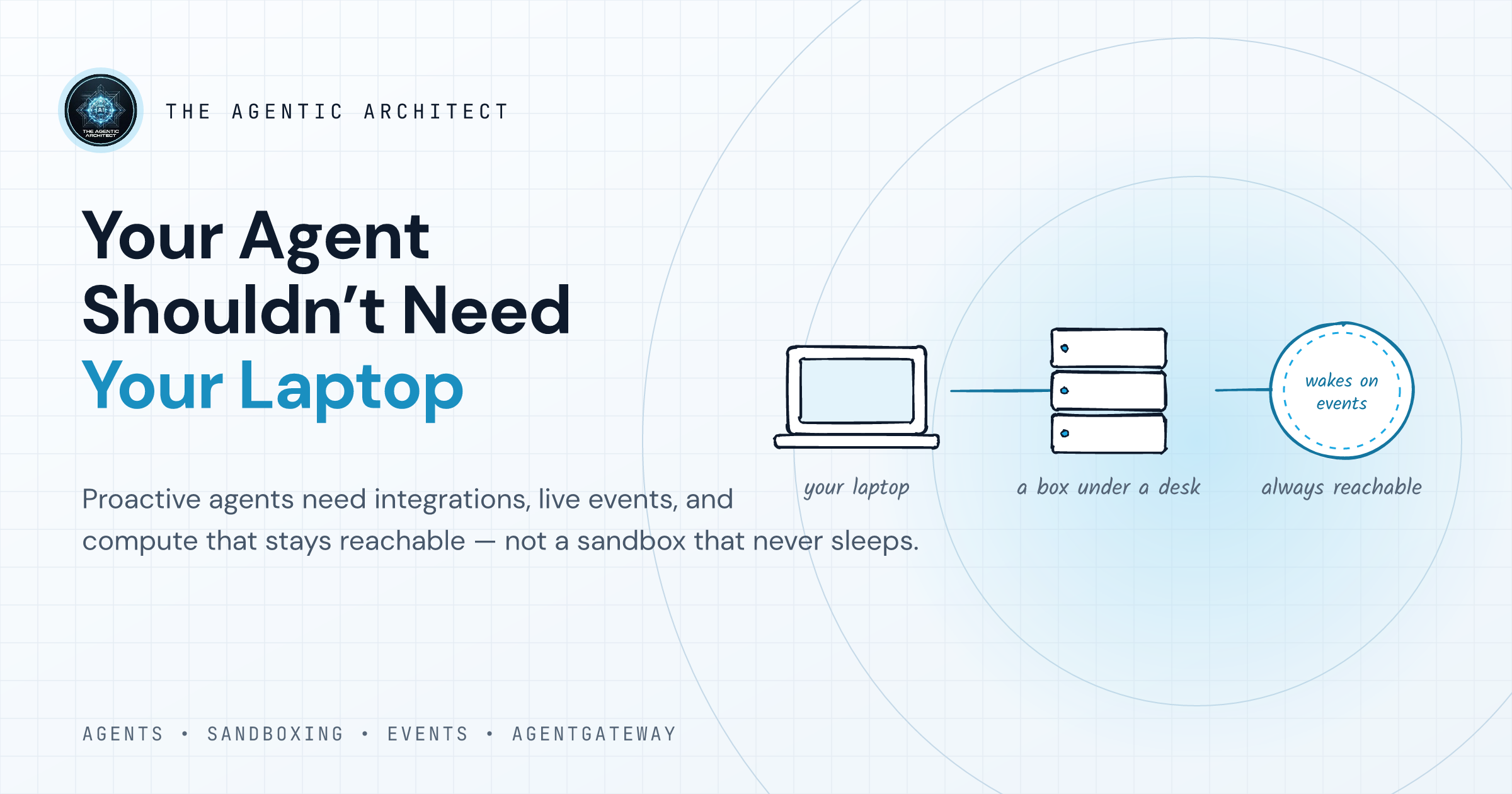
Your Agent Shouldn't Need Your Laptop: an agent moving from a laptop, to a Mac mini under a desk, to a sandbox on shared infrastructure that wakes on events

Your Agent Shouldn't Need Your Laptop

Most of us met AI agents as something we open. You type, the agent works, you close the tab, and the agent stops existing. That is fine for a coding session or a quick question. It does not work for what people actually want from an assistant: something that notices the contract that came in overnight, sees that CI failed after you left, and has a draft response ready before you ask. ...

November 5, 2026 · 9 min · 1835 words · Hugo Guerrero
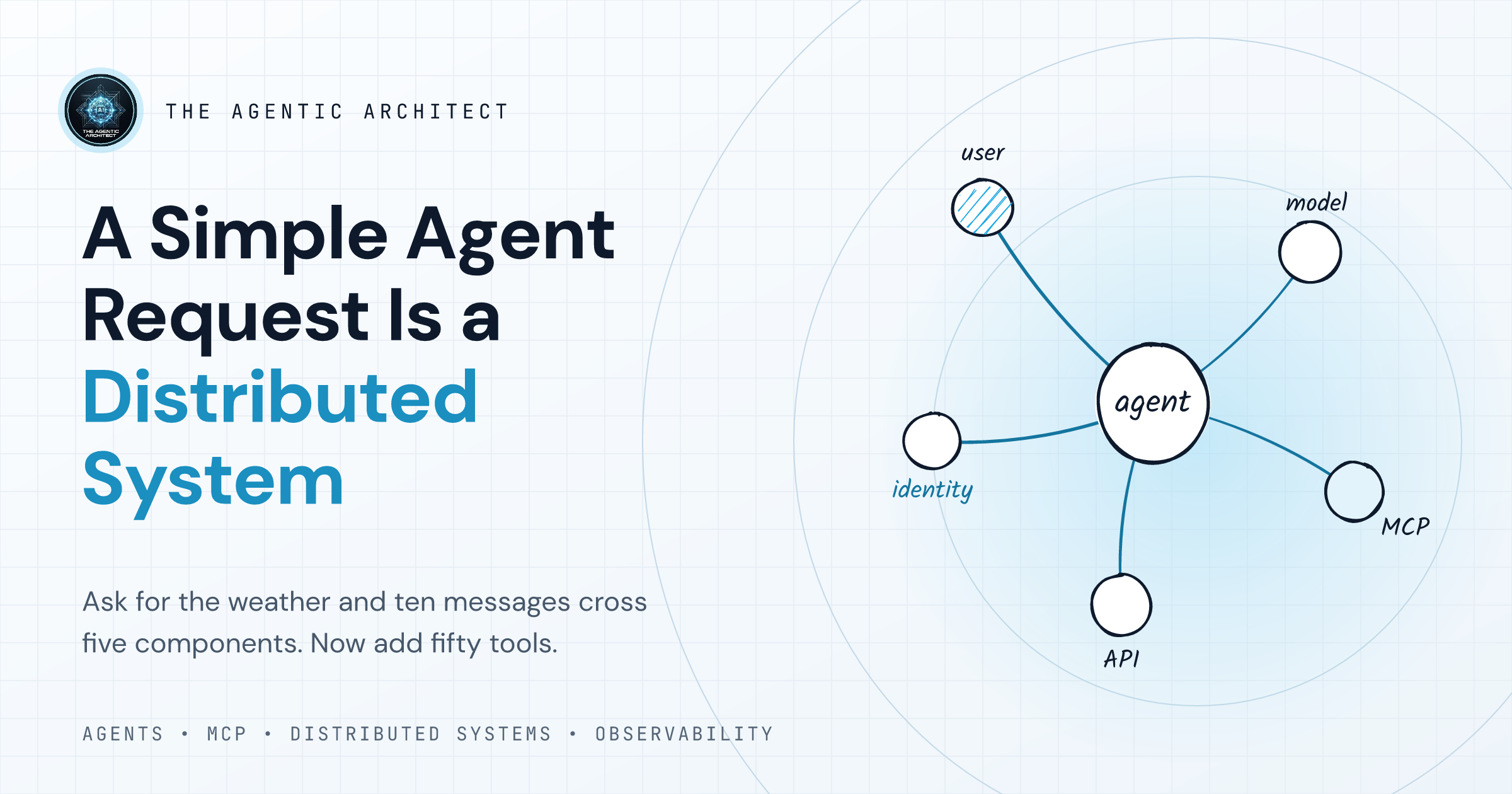
A Simple Agent Request Is a Distributed System — an agent at the center of a web of user, model, MCP server, API, and identity

A Simple Agent Request Is Actually a Distributed System

Ask an agent, “What’s the weather in Boston?” and it feels like one step. You typed a question. You got an answer. Underneath, that one question is a small distributed system. Several components, owned by different parties, exchange messages over networks that can be slow, wrong, or down. Each hop carries context, identity, and risk. None of this is exotic. It is the same class of problem architects have handled for decades. The difference is that most agent demos hide it. ...

November 3, 2026 · 6 min · 1249 words · Hugo Guerrero
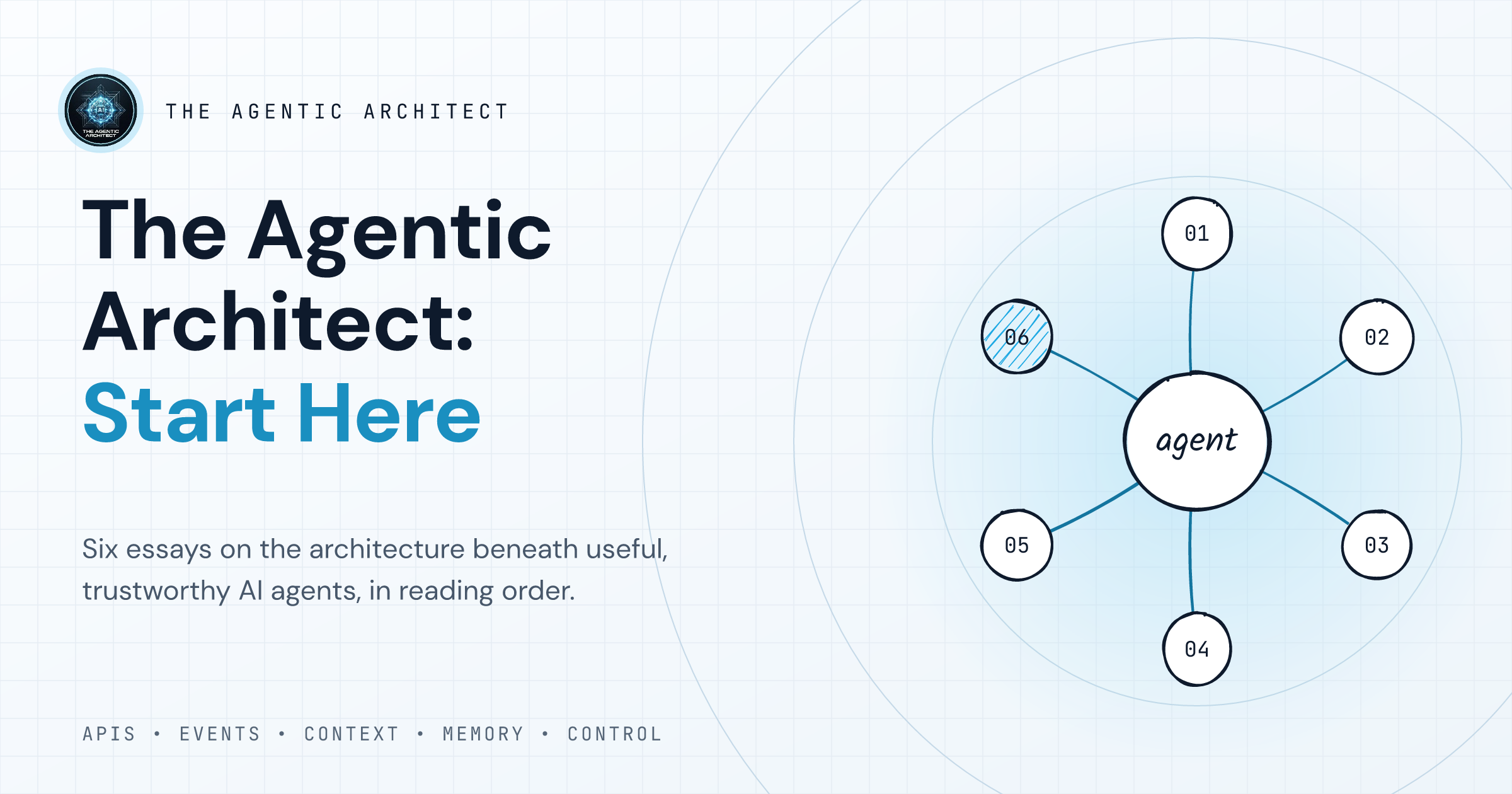
The Agentic Architect: Start Here — six numbered essays orbiting a central agent

Start Here: Six Essays on the Architecture Beneath AI Agents

Everyone is talking about agents. This site is about the architecture underneath them. If you are new here, start with these six essays. They explore the infrastructure that connects agents to the real world: APIs, events, context, memory, tools, and other agents. They are not about finding the perfect model. It was about building systems that can make a capable model useful and safe to trust. They start from a simple observation: intelligence is only one part of an agentic system. An agent also needs timely information, well-designed capabilities, clear authority, a reliable record of what happened, and controls that continue to work when the path through a task is not known in advance. ...

November 2, 2026 · 4 min · 650 words · Hugo Guerrero
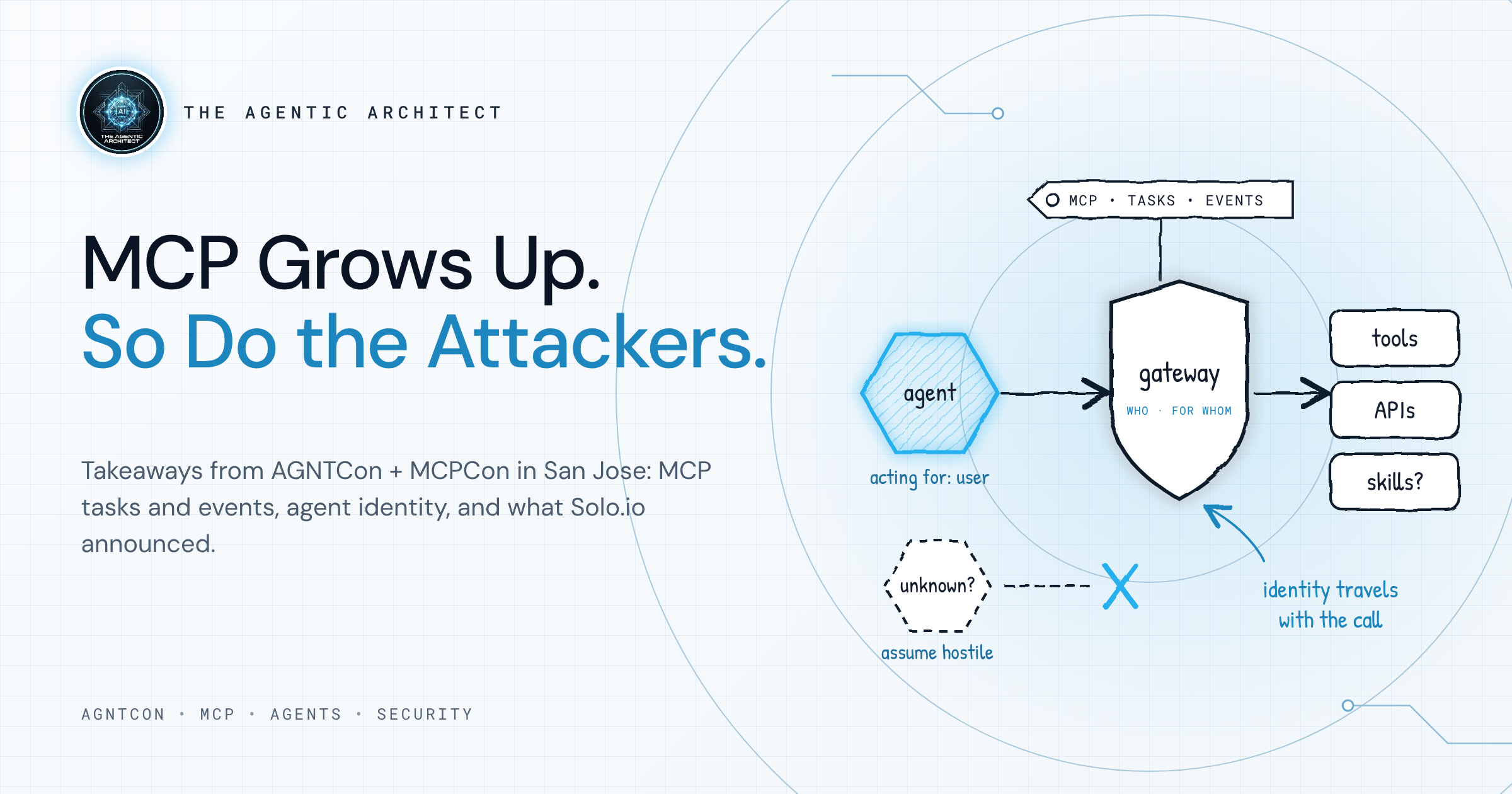
MCP Grows Up. So Do the Attackers. — a sketch of an agent calling tools through a gateway that checks who is acting and for whom, while an unknown agent is blocked

AGNTCon + MCPCon San Jose: MCP Grows Up, and So Do the Attackers

I’m writing this a few days after the end of AGNTCon + MCPCon North America in San Jose. The Amsterdam edition ran a couple of weeks earlier, so this was the second stop of the first year. I spent two days in sessions, hallway conversations, and the Solo.io booth. I recorded a short recap video on the last day, and this post expands on it. One disclosure up front: I work at Solo.io. Several of the announcements below are ours. I have marked them in their own section so you can weigh them accordingly. ...

October 28, 2026 · 8 min · 1567 words · Hugo Guerrero
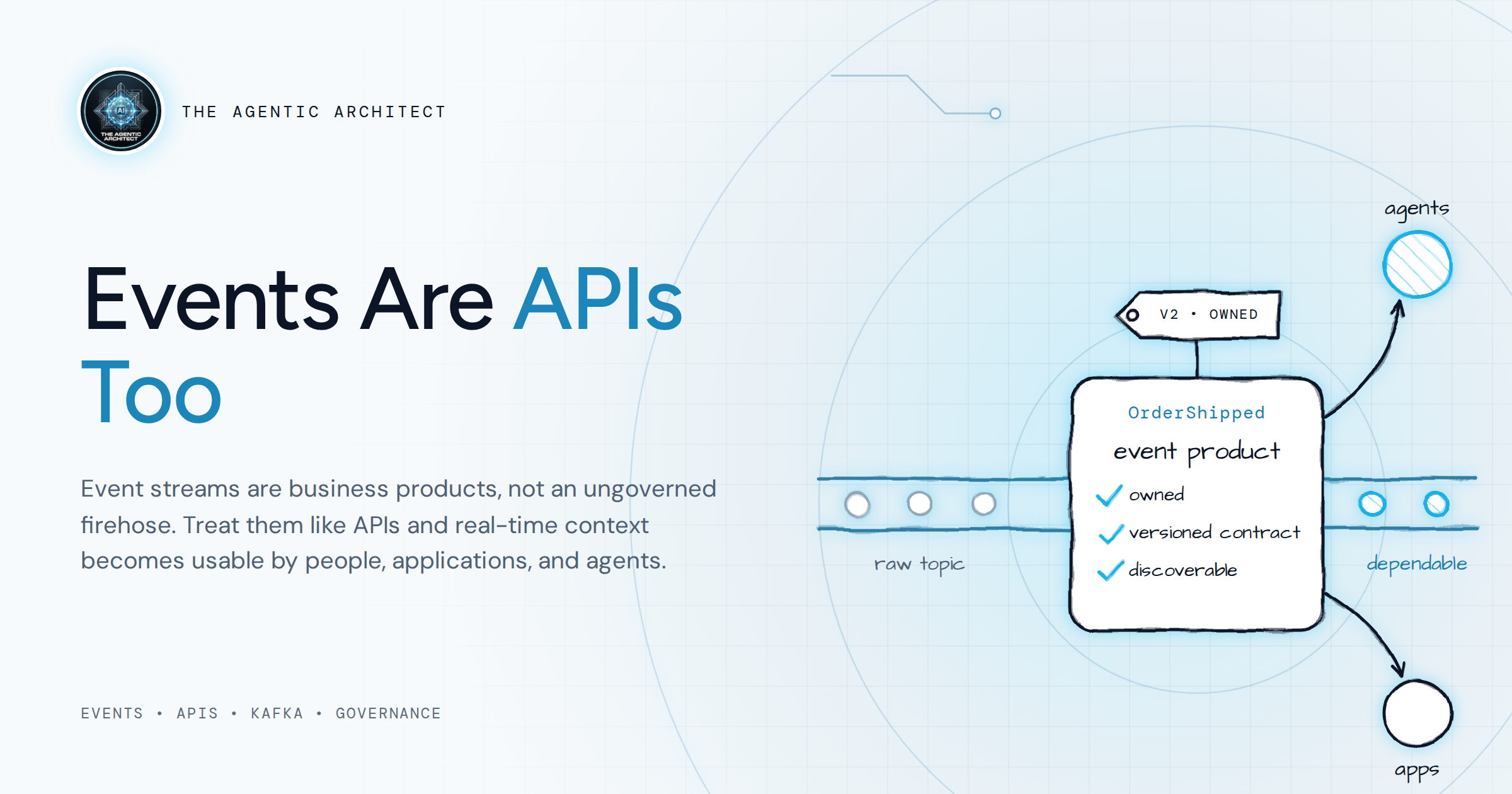
Events Are APIs Too — an OrderShipped event product, versioned and owned, flowing from a raw topic to agents and applications

Events Are APIs Too

APIs made business capabilities reusable. A well-designed API has an owner, a contract, documentation, access controls, a lifecycle, and consumers who can depend on it. Events deserve the same treatment. Too often, event streams are treated as an internal plumbing detail: a collection of topics, schemas, credentials, and conventions understood only by the team that created them. That works until the stream becomes valuable to more than one application—or to an agent that needs timely context. ...

October 27, 2026 · 5 min · 912 words · Hugo Guerrero
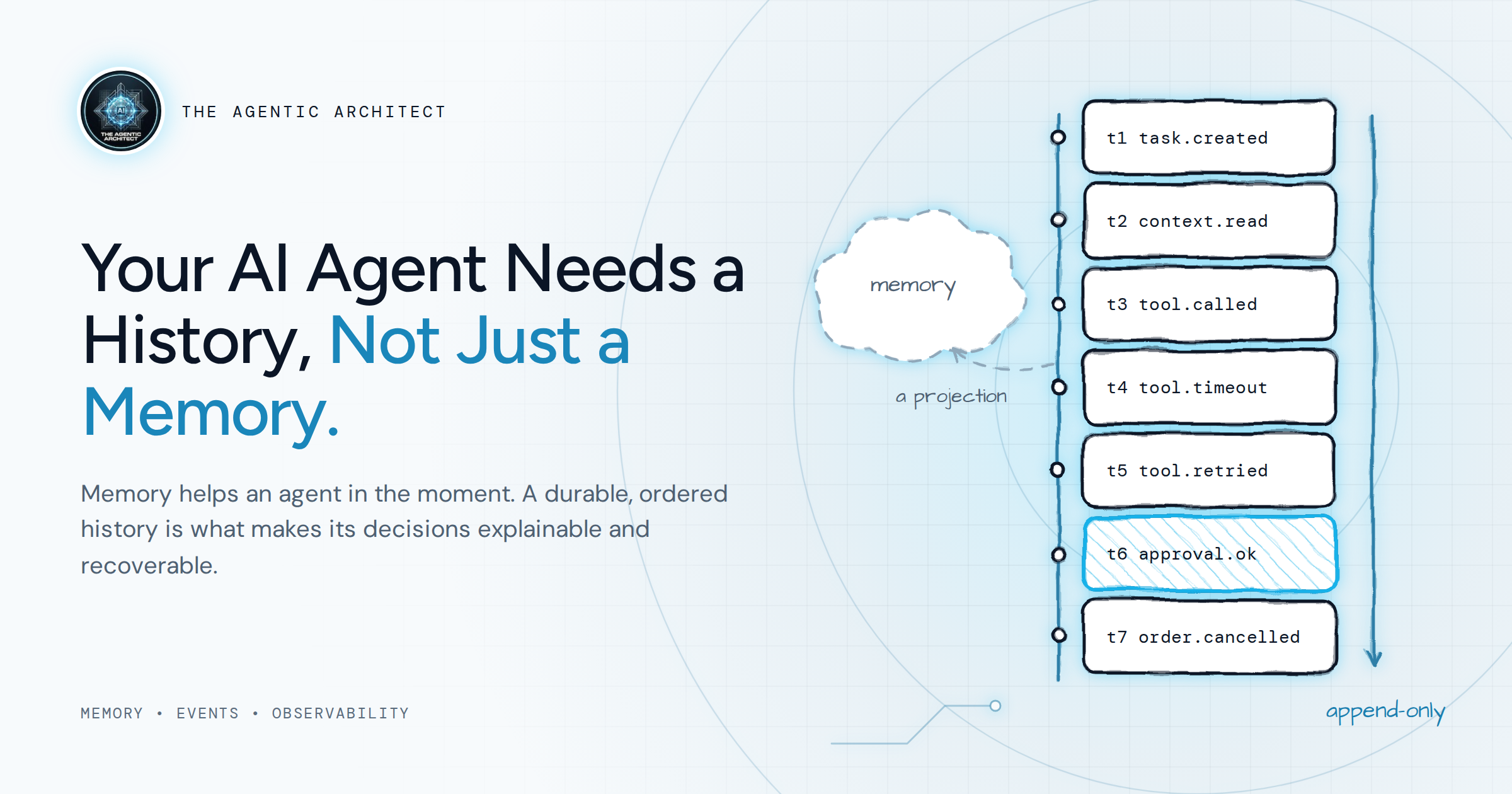
Your AI Agent Needs a History, Not Just a Memory — an append-only ordered log of task events beside a memory cloud that projects from it

Your AI Agent Needs a History, Not Just a Memory.

When an agent gets something wrong, teams often inspect its final answer and the context retrieved for the last model call. That can explain what the agent believed at the end. It rarely explains how it got there. For consequential systems, that distinction matters. An agent needs memory: relevant knowledge from past interactions, retrieved documents, and working state for the task at hand. But memory is not history. Memory answers, “What should I recall now?” History answers, “What happened, in what order, and why did the system reach this state?” ...

October 20, 2026 · 5 min · 922 words · Hugo Guerrero
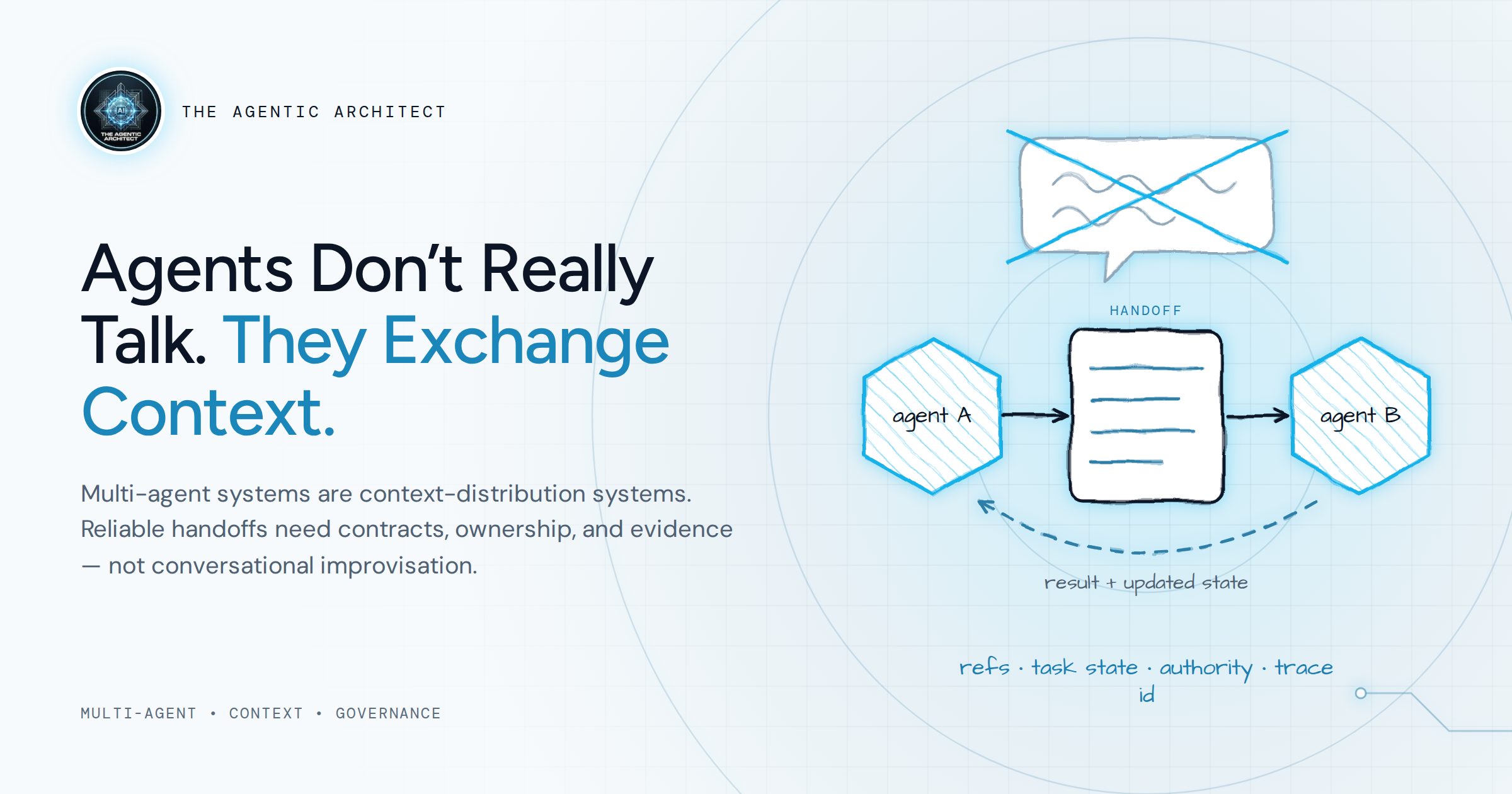
Agents Don’t Really Talk. They Exchange Context — two agents connected by a handoff, not a chat bubble

Agents Don’t Really Talk. They Exchange Context.

Multi-agent demos make it look as though agents are having a conversation: one delegate asks another for research, a specialist returns an answer, and an orchestrator turns it into action. That image is useful, but incomplete. Agents do not collaborate because they can exchange prose. They collaborate because one part of a system can make the right context available to another part at the right time. The architecture of that handoff determines whether a multi-agent workflow is reliable or merely entertaining. ...

October 13, 2026 · 4 min · 804 words · Hugo Guerrero
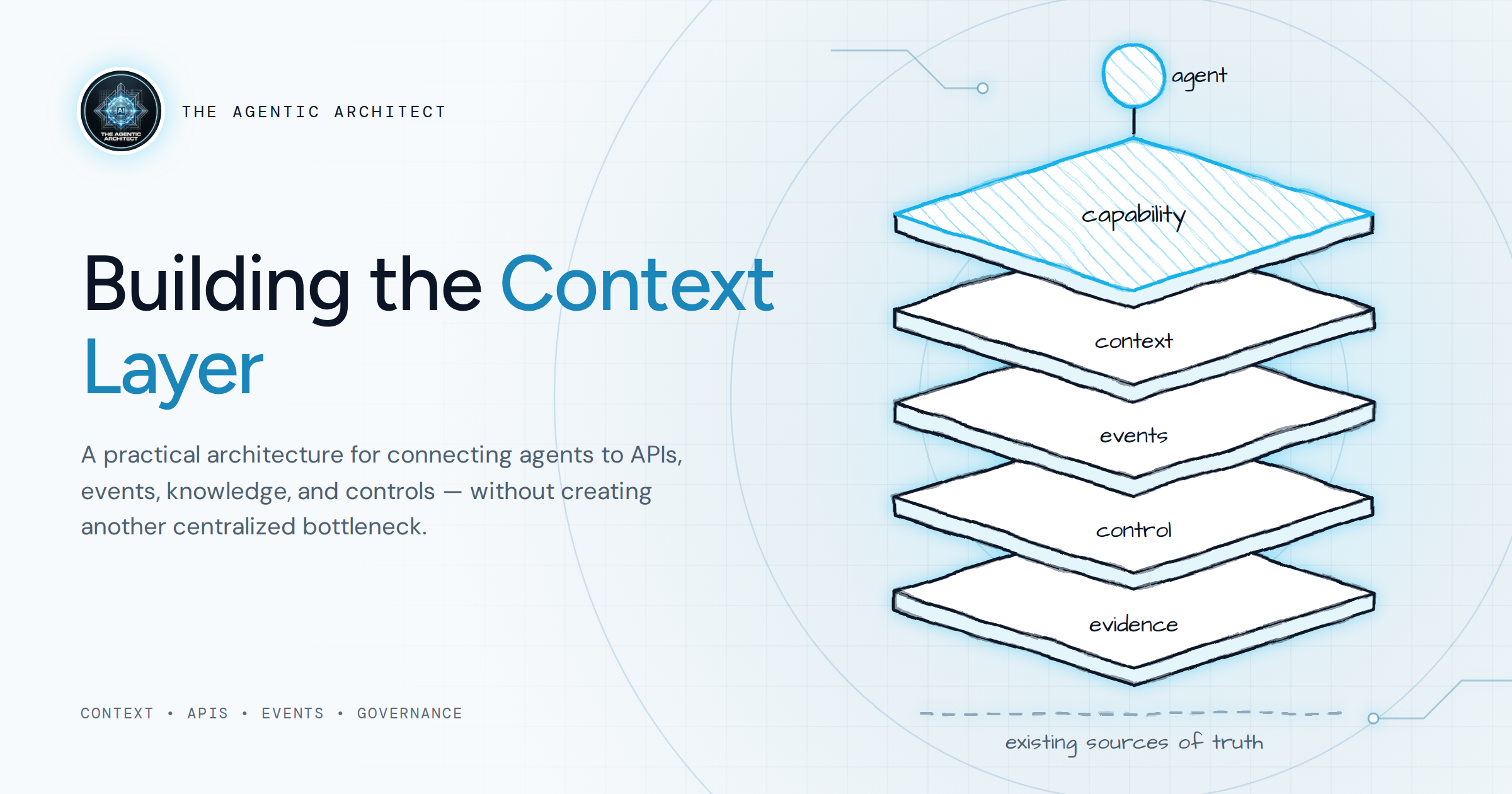
Building the Context Layer — capability, context, event, control, and evidence layers stacked beneath an agent, on top of existing sources of truth

Building the Context Layer

Once an organization accepts that agents need governed, current context, the next question is unavoidable: what do we actually build? The answer is not an all-powerful agent platform that absorbs every system. It is a set of layers that make existing capabilities usable in a new way. The goal is to preserve domain ownership while giving agents a safe, observable path to information and action. Think of the context layer as connective tissue rather than a replacement for the systems that already hold the truth. ...

October 6, 2026 · 5 min · 887 words · Hugo Guerrero
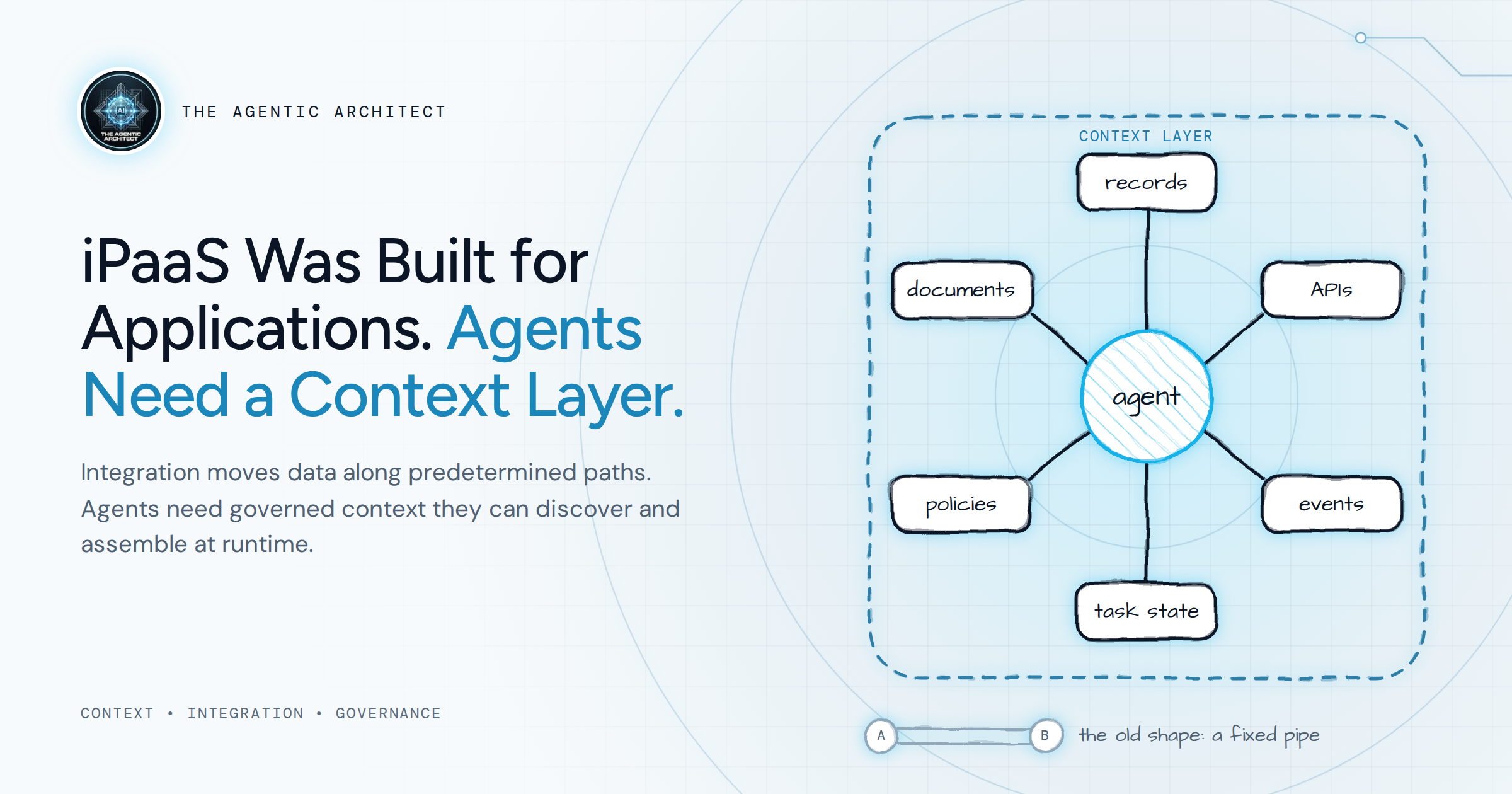
iPaaS Was Built for Applications. Agents Need a Context Layer — a context layer connecting an agent to records, APIs, events, documents, policies, and task state

iPaaS Was Built for Applications. Agents Need a Context Layer.

Integration platforms earned their place in the enterprise by solving a real problem: connect known systems through known flows. An order enters one application, a record is updated in another, and a workflow moves data from point A to point B according to rules someone designed. That model still matters. But it assumes the application knows the journey before it begins. Agents do not always have that luxury. An agent starts with an objective and has to assemble the information and capabilities required to pursue it. It may need a current customer record, an event that just arrived, a policy document, a specialist tool, or an approval from a person. Which of those it needs—and in what order—depends on the task. ...

September 29, 2026 · 5 min · 904 words · Hugo Guerrero